A transparent shop display interface
2014-2015
OVERVIEW
This study focuses on designing an affective user interface for public transparent displays in a store setting. In order to maintain harmonious view and satisfactory experience, the relationship between the information and transparency needs to be considered.
Role
Research idea, User study (Contextual-inquiry, interview, Experiment, Data Analysis), Writing
Idea
Methods


Publication
H. Kim et al “Finding Satisfactory Transparency: An Empirical Study on Public Transparent Displays in a Shop Context”, The ACM SIGCHI Conference on Human Factors in Computing Systems (CHI EA), 2015.
H. Kim et al “From "Overview" to "Detail": An Exploration of Contextual Transparency for Public Transparent Interfaces”, ACM International Conference on Intelligent User Interfaces (IUI Poster), 2015.
Transparent Shop Display
Transparent Game Interfaces
2014
OVERVIEW
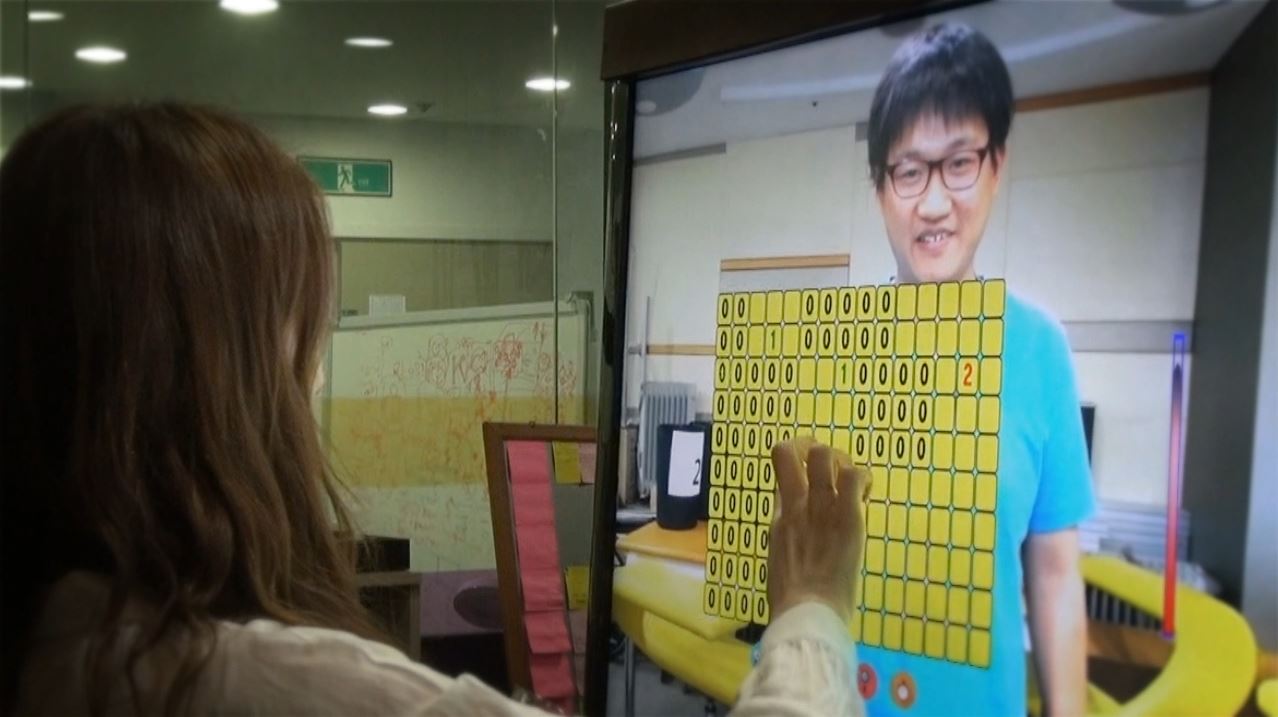
Gplay is a creative technology
and socially desirable home entertainment system that allows two people to
communicate and enjoy games based on gesture interaction and a simple touch.
The system uses two web cameras and depth sensors to
enable people to play an interactive minesweeper game in a face-to-face
state with a transparent display prototype.
Role
Lead project: research, idea generation, hardware prototyping
and software programming
with four team members
with four team members

We
aim to design and develop home entertainment system interfaces for using
transparent
displays at home. By analyzing the new form factors of transparent displays and extracting
the key characteristics – controllable transparency and dual-sided display.
displays at home. By analyzing the new form factors of transparent displays and extracting
the key characteristics – controllable transparency and dual-sided display.
We
also explore how to create a system that simulates natural face-to-face
interactions
in a face-to-face state. In particular, controllable transparency on transparent user interfaces can be effective for competitive situations, such as playing games to win.
in a face-to-face state. In particular, controllable transparency on transparent user interfaces can be effective for competitive situations, such as playing games to win.
A first version of a dual-sided transparent display prototype for communicating by seeing each other and controlling the same object on the dual-sided transparent prototype screen, and also playing a competitive game with individual areas on its screen.
Patent
Domestic
patent “Transparent display apparatus, control method thereof and recording
medium” #10-2014-0079055, Issued June 26, 2014
Copyright
Domestic
software copyright registered “Both-sided minesweeper game” #C-2014-014080,
Issued June 19, 2014
Gplay
Three-level Abstraction Visualization model
mASTER’S DEGREE THESIS
2013-2014
OVERVIEW
An abstraction model for offering a guide to create information visualization for ambient displays in a use of well-known art form.
Role
Research, Theorizing, Visualization making, Usability testing, Writing


RESEARCH Background
While research issues arise concerning on information visualization with various ambient
displays, existing theoretical visualization models can’t provide sufficient guide to visual abstraction process.
displays, existing theoretical visualization models can’t provide sufficient guide to visual abstraction process.
Method
Abstraction Model aims to help mapping the data table appropriately into visual abstraction in information visualization process. This model has three levels and information and visual representation be abstract as the abstraction level rises.
In addition, implement three prototypes with each level of abstraction model and analyze the characteristics of them through comparative experiment , then verify the suitability of information visualization on public ambient displays.
Motion Affordance
We found the most effective visual element is movement, and defined a new term, motion affordance, which basically says that the form induces its motion.
Abstract Visualization
It turned out that although users do not have the full access to the data, they appreciate aesthetic and were able to catch the stock market dynamics.
Publication
H. Kim, K. Wohn, “An Abstraction Model for Information Visualization on Ambient Displays”, IEEE Pacific Visualization, (Poster), March 2014.
Master's Thesis: An Abstraction Model for Information Visualization on Public Ambient Displays
Abstraction Visualization Model for Ambient Displays
An interactive exhibition guide (field guide)
InfoVis course project
2013
Welcome to the Zoo is an interactive visualization and a digital field guide to animals’
hierarchical information for dual display environment. Regarding the investigation on social
behavior and several alternative contexts, my colleague and I discovered that watching animal information at the zoo is a very natural and appropriate way to use dual displays.
Role
Algorithm design, Exhibition space and system design
with one team member
Algorithm design, Exhibition space and system design
with one team member

This visualization can make children to navigate a biological classification who are less likely to have opportunities to experience the nature and the animals nowadays. Children can be guided by exploring the information visualization from many kinds of animals to detailed information and pictures of them. The animal data are extracted from the open data website of Seoul city in South Korea (http://data.seoul.go.kr/).


This visualization is developed to draw a tree map of animal’s information through a pre-processing process of separating and storing the Seoul Grand Park information provided by the data site and made it possible to interact with the information by navigating freely using haptic controller. There are two projectors and two projection space (a wall and a small panel) to display the digital field guide content.
The wall area is to display a global view of the information, and the panel in front of the wall area provided a detail view of the information. When children choose the animal name, leading to the structural animal information from the name of animal cages of the zoo, detailed information will appear on the front panel display.
I used Processing for drawing an interactive visualization and creating the interaction, and design the detailed information with Photoshop.
Exhibition
Exhibited at KAIST L5 Building Lobby in December, 2013
Welcome to the Zoo
User Centered Design Class project
Role
UX Designer: research plan, problem definition, package design and pilot user studies
with four team members
we create
User study method: Multimedia Probe
We develop a new way to gather the user data with multimedia tools based on traditional cultural probe method.
Persona
Based on the user study, we develop persona of break-ups by dividing into three type: “The Sad Charlie”, “I am the best” and “An Inconvenient Truth”. They showed different behavioral aspects when they broke up and overcame.


Four stages after breaking up
Finally, we defined the four stages to overcome after break up.
Solution: Avatar maker
One of our solutions that we proposed is “Avatar maker” which is a location based life simulation game service to allow users to raise an avatar that looks like him or her. According to the user's behaviors based on the check-in data to the location. This service sometime push by giving alert to the user to be more active or interact with others.
Design Method to Know Sensitive User
Interactive media facade system design and body motion detection game development
2013
OVERVIEW
iMove is an interactive motion game, designed to enable university students to participate in the event of the university festival at KAIST. It was installed outside the library building, in front of the main event area, and utilized its facade as a screen through the projection.
Role
Interaction Designer: Media facade system design, Game design and Programming
with seven team members

We discovered that a participatory interactive content is necessary for a place where many people gather, such as university festivals, and thus we created an interactive game that can reinforce the fun and excitement of the event.
In addition, we aimed to change the festival culture by creating an interactive content which allow students to participate in the festival activities and hang out together, instead of simply sitting down and drinking.


iMove game is built by Processing and the system consists of a wall space, instead of a traditional display, with a projector, three kinects and a supporting frame structure. This game is designed to allow people to join and just play the game intuitively by making their body posture which is same as the shape presented on the wall screen.
Additionally, this game allows four people to play at the same time. A high resolution projector is used to display the interactive game screen on the one side of library building and a supporting frame structure which is made of aluminum profiles in 3m x 4m including several LED lights inside it. This media façade system was deployed to leverage the accuracy of detecting people’s motion.
Installation
Installed “iMove”at KAIST Library for KAIST festival in May, 2013
iMove
Contextual interaction design for an optical head-mounted display
designed in the shape of a pair of eyeglasses(such as Google Glass) in future library
HCI Course project
2013
OVERVIEW
My Bookshelf is a context-awareness service in a public library to provide a guide for library goers to explore efficiently the books what they want to find.
Role
Research Plan, Design including problem definition, design method, extract a concept, paper prototyping, wireframe, video prototyping
with one team member


Integrated contextual design technique (affinity diagram) with service design methods (co-creative and service blueprint) based on the conventional interaction design process.
My bookshelf
피드 구독하기:
글
(
Atom
)